



The collagen you drink never arrives at your skin


“The scoop in your coffee is not collagen by the time it leaves your stomach. It is amino acids, and your body decides where those go - not the label.”
A £30-a-month habit built on a mechanism that doesn't exist
You have been taking it every morning. Eight months, maybe longer. Maybe your nails are better. Maybe that is the water you started drinking at the same time. You keep buying it because stopping feels like undoing something, even though you could not say what.
That uncertainty is not you failing to pay attention. It is the entire commercial proposition. Collagen is one of the fastest-growing categories in supplements, and it is built on an assumption nobody selling it has to defend: that swallowing a protein sends it to the place you want it. The pictures on the tub do the arguing. The label never has to.
It is a good business. Cheap to make, easy to explain, impossible to disprove from your own bathroom - and a product you cannot evaluate is a product you never cancel. Here is what is actually happening to it.
Where it actually goes
Collagen is a protein, and your digestive system treats it like any other. Enzymes break it down into individual amino acids and short peptides. Those enter the bloodstream as a general supply, mixed in with everything else you have eaten.
There is no courier service. Nothing tags those amino acids as skin-bound. Your body allocates them the way it allocates all protein - according to what it is currently doing, in an order it decides.
Broken apart
Digestive enzymes reduce the scoop to amino acids. The collagen no longer exists as collagen.
Pooled, not posted
They join one general supply. Your body spends it wherever it is already working.
Burned or stored
Surplus is not kept as protein. Nitrogen is excreted and the carbon left behind becomes glucose or fat.
Published metabolic research is unambiguous on that last step. Protein you have no current use for is not banked for later - it is fuel, and expensive fuel at that.
Eating collagen does not put collagen in your skin, any more than eating steak builds biceps.
Protein you don't have a use for is expensive fuel, nothing more.
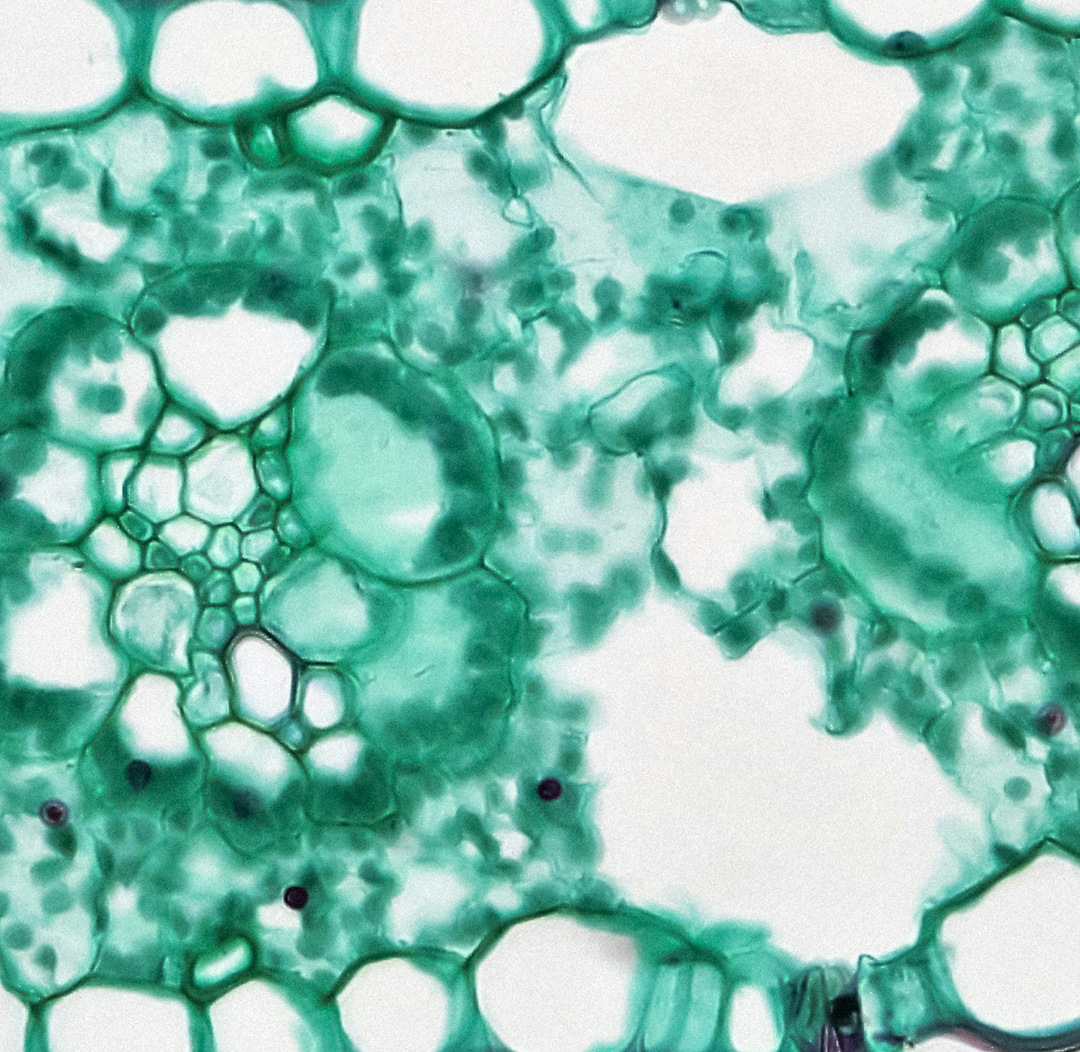
Nothing in your body is delivered. It is built.
Collagen is not a special case. Every structure you have is manufactured on site by cells - skin, muscle, bone, hair, the lining of your gut, the enzymes that digest your food, the neurotransmitters that decide what kind of mood you are in. Cells run all of it.
And every one of those jobs costs energy. Which is why supplying more raw material rarely changes much: if amino acids were the bottleneck, anyone eating enough protein would already have solved this. The constraint is not what the cell has to work with. It is how much work the cell can afford to do.
One molecule pays for all of it
NAD⁺ is the coenzyme mitochondria use to make energy, and the same one repair enzymes need to clear damage. Every cell in your body depends on it - which means everything downstream of a cell does too.
It declines steadily with age. By your forties you are running on roughly half what you had at 25. Nothing feels broken. Output is simply lower everywhere at once, which is why the changes people notice in their thirties and forties arrive together rather than one at a time - energy, recovery, sleep, skin.
Blood NAD⁺ against participants' own baseline after 14 days of nicotinamide riboside supplementation.¹
What MUTO is
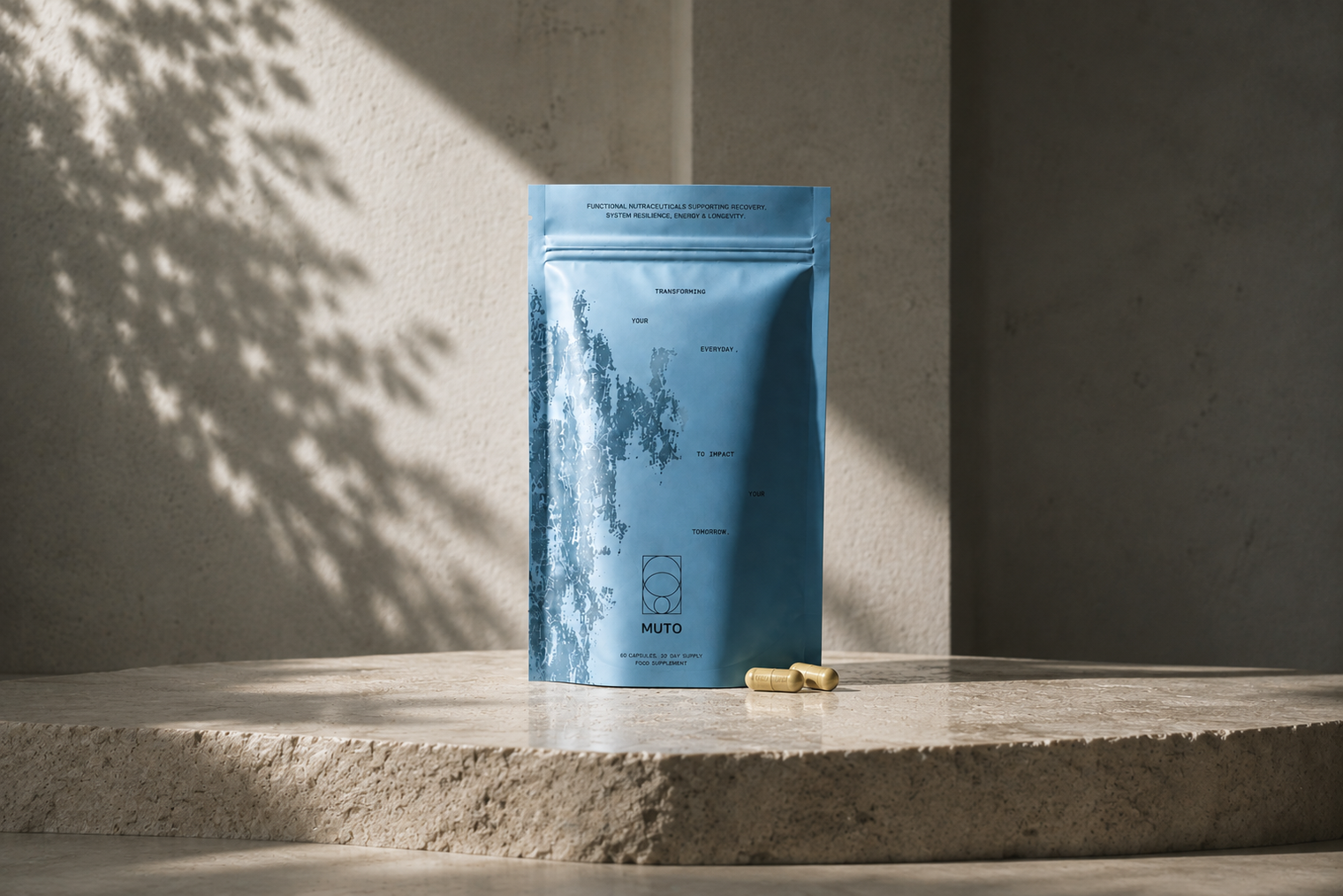
One product. Sixty capsules, a thirty-day supply, two a day. A cellular energy formula built around nicotinamide riboside - the raw material your body converts into NAD⁺ - working on the production side rather than the supply side. Three jobs, no overlap:
Nicotinamide riboside at 300mg, plus zinc, copper and six B vitamins in active forms - the cofactors NAD⁺ production and use depend on.
Your body breaks NAD⁺ down as fast as it makes it. Pterostilbene, quercetin, grapeseed and turmeric extract are there to keep raised levels raised for longer.
CoQ10 to help mitochondria convert it into usable energy, and BioPerine® so the formula is absorbed rather than passed through.
Why this is a better bet than another collagen tub
Supplies a raw material
One you likely already have enough of, delivered to a general pool your body allocates as it sees fit. For one job only.
Funds the production
Works on cellular energy and repair capacity - the constraint that limits every job your cells do, not just one of them.
Printed in full, at the levels used in the research they come from. No proprietary blends.
Dr Richie Barclay, PhD molecular biologist, and reviewed by a six-person scientific advisory board before manufacture.
In the UK to GMP ISO standard, tested by an independent lab for purity and potency.
No stimulants, no fillers, no unnecessary excipients. Nothing to feel in the first hour, deliberately.
What to expect, honestly
Energy arrives first. There are no stimulants in the formula, so nothing happens in the first hour - but most people describe the afternoon dip going somewhere in weeks three to four, and mornings feeling less like a negotiation. Anything structural is slower, and nobody credible can promise you a date.
Take it for ninety days, which is long enough to know. If you are not convinced, tell us and we refund you. No returned pouches, no argument.

£29 for your first month, then £55
Up to 58% off the one-time price. Cancel any time. 90-day money-back guarantee.
¹ Conze, D., Brenner, C., & Kruger, C. L. (2019). Scientific Reports, 9(1), 9772. Blood NAD⁺ measured against participants' own baseline over 14 days of nicotinamide riboside supplementation.
MUTO is a food supplement and is not intended to diagnose, treat, cure or prevent any disease. It is not a skincare treatment and is not a substitute for a varied diet, sleep or sun protection. If you are pregnant, breastfeeding or taking prescribed medication, speak to your doctor before use. Views expressed are those of the named advisor. Timings described are typical and not guaranteed; individual results vary.


